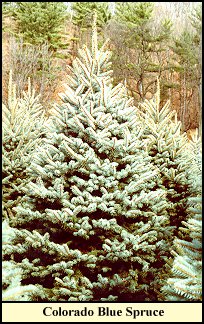
Colorado blue spruce, or blue spruce, is an attractive tree often used for Christmas trees or as ornamentals, particularly in the eastern United States and Europe. It is the official state tree of both Colorado and Utah. The species generally reaches a height of 65-115 feet at maturity with a diameter of 2-3 feet. It has a narrow, pyramidal shape and cone-shaped crown. As trees become older, they often take on a more irregular appearance. While blue spruce grows relatively slowly, it is long-lived and may reach ages of 600-800 years.
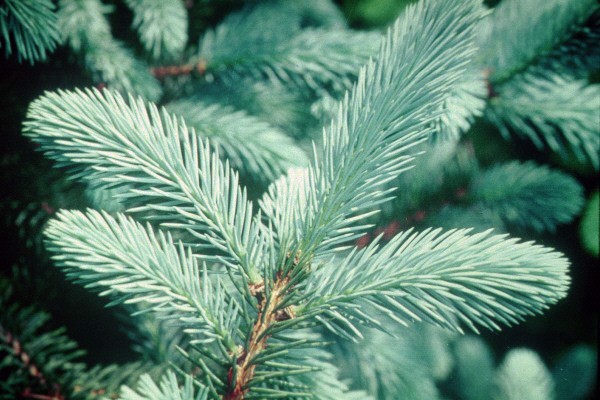
Leaves (needles) are 1-1 1/2 inches
long on lower branches but somewhat shorter on upper branches. They are 4-sided and have a very sharp point on the end. It is this point which gives the species its name "pungens", from the Latin word for sharp as in puncture wound. Needles are generally dull bluish-gray to silvery blue and emit a resinous odor when crushed. Some trees have a more distinct bluish-white or silvery-white foliage. The cultivated variety 'glauca' is noted for this type of coloration. Nursery managers also select for "shiners" which demonstrate this very desirable characteristic. Needles occur on small peg-like structures on the twig called sterigmata. The sterigmata persist on the twigs after needles have fallen, which is usually after the third or fourth year.
Both male and female flowers (strobili) occur in the same tree, although in different locations. Pollination occurs in late spring and cones mature in one season. In the fall, cones are 2-4 inches long and turn chestnut brown with stiff, flattened scales. Cones generally persist on the tree for one to two years after seed fall.
The bark is thin becoming moderately thick with age. It is somewhat pale gray in small flattened scales when young, then turns reddish brown and furrowed with age.
Blue spruce is moderately shade tolerant and grows best in deep, rich, gravely soils, often along stream banks and other sites with high moisture levels. It usually does not occur in large stands but is found in small groves or in association with Douglas-fir, lodgepole pine, Engelmann spruce or ponderosa pine. A deep penetrating root system makes the species resistant to being blown over.
Major pests include the western spruce dwarf mistletoe, spruce bark beetle, and spruce budworm. Trees infected with mistletoe typically develop abnormal masses of branches called "witches brooms". With severe infestations, trees may be killed.
Blue spruce is finding increasing popularity as a Christmas tree as a result of its symmetrical form and attractive blue foliage. The species has an excellent natural shape and requires little shearing. Additionally, needle retention is among the best for the spruces. Its popularity as an ornamental leads many consumers to use blue spruce as a living Christmas tree, to be planted after the holiday season.






 SEARCH


 long on lower branches but somewhat shorter on upper branches. They are 4-sided and have a very sharp point on the end. It is this point which gives the species its name "pungens", from the Latin word for sharp as in puncture wound. Needles are generally dull bluish-gray to silvery blue and emit a resinous odor when crushed. Some trees have a more distinct bluish-white or silvery-white foliage. The cultivated variety 'glauca' is noted for this type of coloration. Nursery managers also select for "shiners" which demonstrate this very desirable characteristic. Needles occur on small peg-like structures on the twig called sterigmata. The sterigmata persist on the twigs after needles have fallen, which is usually after the third or fourth year.
Both male and female flowers (strobili) occur in the same tree, although in different locations. Pollination occurs in late spring and cones mature in one season. In the fall, cones are 2-4 inches long and turn chestnut brown with stiff, flattened scales. Cones generally persist on the tree for one to two years after seed fall.
The bark is thin becoming moderately thick with age. It is somewhat pale gray in small flattened scales when young, then turns reddish brown and furrowed with age.
Blue spruce is moderately shade tolerant and grows best in deep, rich, gravely soils, often along stream banks and other sites with high moisture levels. It usually does not occur in large stands but is found in small groves or in association with Douglas-fir, lodgepole pine, Engelmann spruce or ponderosa pine. A deep penetrating root system makes the species resistant to being blown over.
Major pests include the western spruce dwarf mistletoe, spruce bark beetle, and spruce budworm. Trees infected with mistletoe typically develop abnormal masses of branches called "witches brooms". With severe infestations, trees may be killed.
Blue spruce is finding increasing popularity as a Christmas tree as a result of its symmetrical form and attractive blue foliage. The species has an excellent natural shape and requires little shearing. Additionally, needle retention is among the best for the spruces. Its popularity as an ornamental leads many consumers to use blue spruce as a living Christmas tree, to be planted after the holiday season.
long on lower branches but somewhat shorter on upper branches. They are 4-sided and have a very sharp point on the end. It is this point which gives the species its name "pungens", from the Latin word for sharp as in puncture wound. Needles are generally dull bluish-gray to silvery blue and emit a resinous odor when crushed. Some trees have a more distinct bluish-white or silvery-white foliage. The cultivated variety 'glauca' is noted for this type of coloration. Nursery managers also select for "shiners" which demonstrate this very desirable characteristic. Needles occur on small peg-like structures on the twig called sterigmata. The sterigmata persist on the twigs after needles have fallen, which is usually after the third or fourth year.
Both male and female flowers (strobili) occur in the same tree, although in different locations. Pollination occurs in late spring and cones mature in one season. In the fall, cones are 2-4 inches long and turn chestnut brown with stiff, flattened scales. Cones generally persist on the tree for one to two years after seed fall.
The bark is thin becoming moderately thick with age. It is somewhat pale gray in small flattened scales when young, then turns reddish brown and furrowed with age.
Blue spruce is moderately shade tolerant and grows best in deep, rich, gravely soils, often along stream banks and other sites with high moisture levels. It usually does not occur in large stands but is found in small groves or in association with Douglas-fir, lodgepole pine, Engelmann spruce or ponderosa pine. A deep penetrating root system makes the species resistant to being blown over.
Major pests include the western spruce dwarf mistletoe, spruce bark beetle, and spruce budworm. Trees infected with mistletoe typically develop abnormal masses of branches called "witches brooms". With severe infestations, trees may be killed.
Blue spruce is finding increasing popularity as a Christmas tree as a result of its symmetrical form and attractive blue foliage. The species has an excellent natural shape and requires little shearing. Additionally, needle retention is among the best for the spruces. Its popularity as an ornamental leads many consumers to use blue spruce as a living Christmas tree, to be planted after the holiday season.



