Norway spruce is one of the most important species on the European Continent.
More than 100 forms and varieties have been named. Although not native to the Western hemisphere, the species and a number of its varieties are commonly planted here, particularly in southeastern Canada and northeastern United States. Originally, a number of plants were established as ornamentals, with Christmas tree plantings being established more recently. It has escaped cultivation in several localities and is considered naturalized in some of these areas.
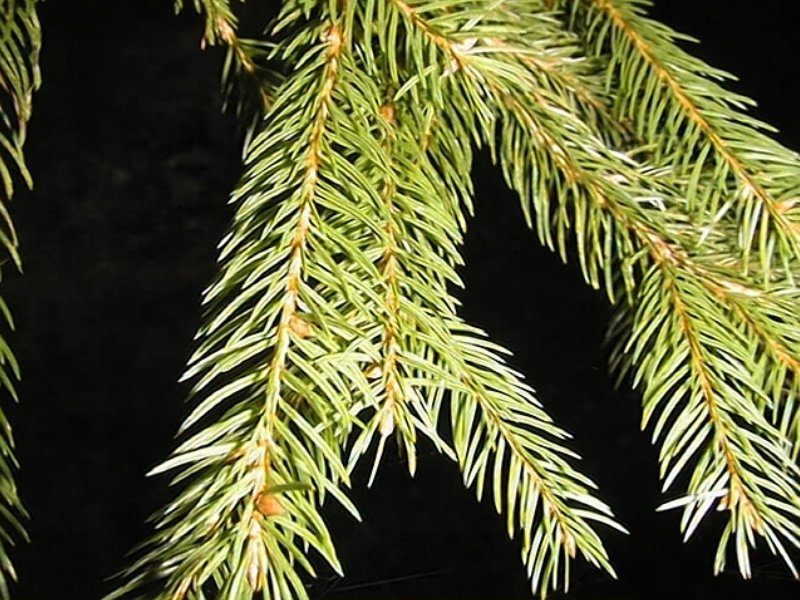
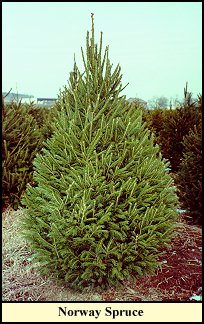
In Europe, Norway spruce grows from 130 to 215 feet in height, but in the United States is seldom more than 130 feet tall. Diameter may reach as much as two feet on older trees. It is readily identified by its dark green needles and drooping branchlets. Trees have dark green crown with a triangular shape. Leaves (needles) are 4-sided (rectangular in section), 1/2-1 inch long, and sharp or somewhat blunt at the tip. At the base of each needle is a twig-like projection (sterigmata) which remains after the needle is lost. Although sometimes confused with true firs (Abies), spruces in general have 1) rectangular rather than flat needles, and 2) cones which hang down rather than stand erect on the stem. Additionally, spruce cones fall from the tree after seeds are disseminated, whereas fir cones disintegrate.
Male and female flowers are found on the same tree and are produced in late spring. Norway Spruce produces cones 4-7 inches in length, with wedge-shaped scales. These cones are the largest of any spruce species. Cones mature in one year and ripen from September to November.
The species has a reddish bark, giving it the nickname of "red fir", which flakes off in scales as the tree matures.
The species is adapted to cool, temperate climates. Growth is best in full sunlight in deep, rich, moist soils. It is generally shallow-rooted and does not produce a taproot, thus is subject to being blown over by wind.
One of the most important pests is the eastern spruce gall aphid, which lays eggs at the base of partially developed leaves near the tips of the twigs. A large cone-like gall develops at this point, beyond which all growth ceases. The spruce budworm can also cause damage to buds and foliage, but less so than for white or red spruce.
For Christmas trees, overall color of Norway spruce is fair to excellent, but needle retention is considered poor unless the trees are cut fresh and kept properly watered. Growth during the first 10 years after field planting is relatively slow and 8 to 11 years are required to grow a 6-7 foot tree.






 SEARCH





 More than 100 forms and varieties have been named. Although not native to the Western hemisphere, the species and a number of its varieties are commonly planted here, particularly in southeastern Canada and northeastern United States. Originally, a number of plants were established as ornamentals, with Christmas tree plantings being established more recently. It has escaped cultivation in several localities and is considered naturalized in some of these areas.
In Europe, Norway spruce grows from 130 to 215 feet in height, but in the United States is seldom more than 130 feet tall. Diameter may reach as much as two feet on older trees. It is readily identified by its dark green needles and drooping branchlets. Trees have dark green crown with a triangular shape. Leaves (needles) are 4-sided (rectangular in section), 1/2-1 inch long, and sharp or somewhat blunt at the tip. At the base of each needle is a twig-like projection (sterigmata) which remains after the needle is lost. Although sometimes confused with true firs (Abies), spruces in general have 1) rectangular rather than flat needles, and 2) cones which hang down rather than stand erect on the stem. Additionally, spruce cones fall from the tree after seeds are disseminated, whereas fir cones disintegrate.
Male and female flowers are found on the same tree and are produced in late spring. Norway Spruce produces cones 4-7 inches in length, with wedge-shaped scales. These cones are the largest of any spruce species. Cones mature in one year and ripen from September to November.
The species has a reddish bark, giving it the nickname of "red fir", which flakes off in scales as the tree matures.
The species is adapted to cool, temperate climates. Growth is best in full sunlight in deep, rich, moist soils. It is generally shallow-rooted and does not produce a taproot, thus is subject to being blown over by wind.
One of the most important pests is the eastern spruce gall aphid, which lays eggs at the base of partially developed leaves near the tips of the twigs. A large cone-like gall develops at this point, beyond which all growth ceases. The spruce budworm can also cause damage to buds and foliage, but less so than for white or red spruce.
For Christmas trees, overall color of Norway spruce is fair to excellent, but needle retention is considered poor unless the trees are cut fresh and kept properly watered. Growth during the first 10 years after field planting is relatively slow and 8 to 11 years are required to grow a 6-7 foot tree.
More than 100 forms and varieties have been named. Although not native to the Western hemisphere, the species and a number of its varieties are commonly planted here, particularly in southeastern Canada and northeastern United States. Originally, a number of plants were established as ornamentals, with Christmas tree plantings being established more recently. It has escaped cultivation in several localities and is considered naturalized in some of these areas.
In Europe, Norway spruce grows from 130 to 215 feet in height, but in the United States is seldom more than 130 feet tall. Diameter may reach as much as two feet on older trees. It is readily identified by its dark green needles and drooping branchlets. Trees have dark green crown with a triangular shape. Leaves (needles) are 4-sided (rectangular in section), 1/2-1 inch long, and sharp or somewhat blunt at the tip. At the base of each needle is a twig-like projection (sterigmata) which remains after the needle is lost. Although sometimes confused with true firs (Abies), spruces in general have 1) rectangular rather than flat needles, and 2) cones which hang down rather than stand erect on the stem. Additionally, spruce cones fall from the tree after seeds are disseminated, whereas fir cones disintegrate.
Male and female flowers are found on the same tree and are produced in late spring. Norway Spruce produces cones 4-7 inches in length, with wedge-shaped scales. These cones are the largest of any spruce species. Cones mature in one year and ripen from September to November.
The species has a reddish bark, giving it the nickname of "red fir", which flakes off in scales as the tree matures.
The species is adapted to cool, temperate climates. Growth is best in full sunlight in deep, rich, moist soils. It is generally shallow-rooted and does not produce a taproot, thus is subject to being blown over by wind.
One of the most important pests is the eastern spruce gall aphid, which lays eggs at the base of partially developed leaves near the tips of the twigs. A large cone-like gall develops at this point, beyond which all growth ceases. The spruce budworm can also cause damage to buds and foliage, but less so than for white or red spruce.
For Christmas trees, overall color of Norway spruce is fair to excellent, but needle retention is considered poor unless the trees are cut fresh and kept properly watered. Growth during the first 10 years after field planting is relatively slow and 8 to 11 years are required to grow a 6-7 foot tree.


