First described in 1768, balsam fir is a medium-sized tree
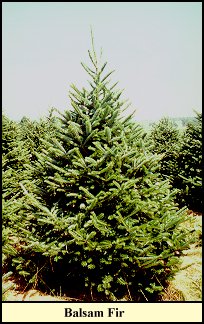
generally reaching 40-60 feet in height and 1-1 1/2 feet in diameter. It exhibits a relatively dense, dark-green, pyramidal crown with a slender spire-like tip. The scientific name "balsamea" is an ancient word for the balsam tree, so named because of the many resinous blisters found in the bark. Balsam fir and Fraser fir have many similar characteristics, although geographic ranges of the two species do not overlap.
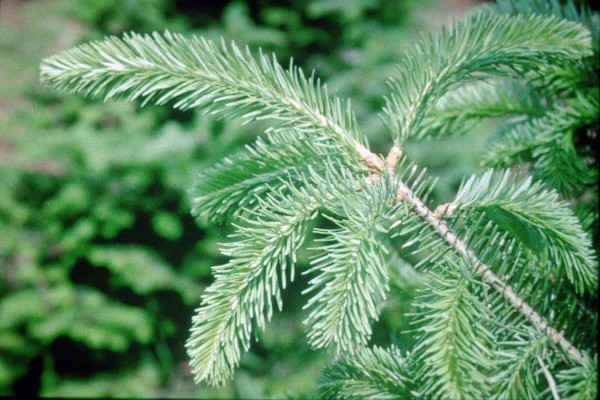
On lower branches needles generally occur as two-ranked (two rows along sides of the branch), 3/4 - 1 1/2 inches long, spreading and not crowded. On older branches, the needles tend to be shorter and curved upward so as to cover the upper sides of the twigs. Individual needles are somewhat flat and may be blunt or notched at the end. Needles have a broad circular base and are usually dark green on the upper surface, lighter on the lower surface. Two silvery bands of stomata (pores) are found on the lower surface.
Balsam fir has both male and female flowers (or strobili) on the same tree. Flowers are receptive in late May to early June. The species is wind pollinated, and cones mature in a single season. At maturity, cones are 2 to 3 1/2 inches long with bracts shorter than scales. The presence of these short cone bracts is a distinguishing feature when balsam fir is compared Fraser fir. Upon ripening in September to November, cones fall apart leaving an erect central core.
Balsam fir bark is thin, ash-gray, and smooth except for numerous blisters on young trees. These blisters contain a sticky, fragrant, liquid resin. Thus, the species has been sometimes referred to as "blister pine". Upon maturity, bark may become up to 1/2 inch thick, red-brown and broken into thin scales.
The species thrives in cooler climates and demands abundant soil moisture and a humid atmosphere. It is generally found in the Canadian and Hudsonian zones from sea level to about 5,000 feet in elevation. Growth is best on well-drained, sandy loam soils that are somewhat acid. The species is tolerant of shade and may reach 150-200 years of age. Pure stands may be found in swamps, but balsam fir often occurs with white spruce, black spruce and aspen on upland sites.
Chief enemies are the spruce budworm and balsam woolly adelgid (formerly called an aphid), heart-rot fungi, and fire. A shallow root system also renders the trees vulnerable to high winds and heavy spring snow storms.
As a Christmas tree, balsam fir has several desirable properties. It has a dark-green appearance, long-lasting needles, and attractive form. It also retains its pleasing fragrance. Nine to ten years in the field are required to produce a 6-7 foot tree.





 SEARCH


 generally reaching 40-60 feet in height and 1-1 1/2 feet in diameter. It exhibits a relatively dense, dark-green, pyramidal crown with a slender spire-like tip. The scientific name "balsamea" is an ancient word for the balsam tree, so named because of the many resinous blisters found in the bark. Balsam fir and Fraser fir have many similar characteristics, although geographic ranges of the two species do not overlap.
On lower branches needles generally occur as two-ranked (two rows along sides of the branch), 3/4 - 1 1/2 inches long, spreading and not crowded. On older branches, the needles tend to be shorter and curved upward so as to cover the upper sides of the twigs. Individual needles are somewhat flat and may be blunt or notched at the end. Needles have a broad circular base and are usually dark green on the upper surface, lighter on the lower surface. Two silvery bands of stomata (pores) are found on the lower surface.
Balsam fir has both male and female flowers (or strobili) on the same tree. Flowers are receptive in late May to early June. The species is wind pollinated, and cones mature in a single season. At maturity, cones are 2 to 3 1/2 inches long with bracts shorter than scales. The presence of these short cone bracts is a distinguishing feature when balsam fir is compared Fraser fir. Upon ripening in September to November, cones fall apart leaving an erect central core.
Balsam fir bark is thin, ash-gray, and smooth except for numerous blisters on young trees. These blisters contain a sticky, fragrant, liquid resin. Thus, the species has been sometimes referred to as "blister pine". Upon maturity, bark may become up to 1/2 inch thick, red-brown and broken into thin scales.
The species thrives in cooler climates and demands abundant soil moisture and a humid atmosphere. It is generally found in the Canadian and Hudsonian zones from sea level to about 5,000 feet in elevation. Growth is best on well-drained, sandy loam soils that are somewhat acid. The species is tolerant of shade and may reach 150-200 years of age. Pure stands may be found in swamps, but balsam fir often occurs with white spruce, black spruce and aspen on upland sites.
Chief enemies are the spruce budworm and balsam woolly adelgid (formerly called an aphid), heart-rot fungi, and fire. A shallow root system also renders the trees vulnerable to high winds and heavy spring snow storms.
As a Christmas tree, balsam fir has several desirable properties. It has a dark-green appearance, long-lasting needles, and attractive form. It also retains its pleasing fragrance. Nine to ten years in the field are required to produce a 6-7 foot tree.
generally reaching 40-60 feet in height and 1-1 1/2 feet in diameter. It exhibits a relatively dense, dark-green, pyramidal crown with a slender spire-like tip. The scientific name "balsamea" is an ancient word for the balsam tree, so named because of the many resinous blisters found in the bark. Balsam fir and Fraser fir have many similar characteristics, although geographic ranges of the two species do not overlap.
On lower branches needles generally occur as two-ranked (two rows along sides of the branch), 3/4 - 1 1/2 inches long, spreading and not crowded. On older branches, the needles tend to be shorter and curved upward so as to cover the upper sides of the twigs. Individual needles are somewhat flat and may be blunt or notched at the end. Needles have a broad circular base and are usually dark green on the upper surface, lighter on the lower surface. Two silvery bands of stomata (pores) are found on the lower surface.
Balsam fir has both male and female flowers (or strobili) on the same tree. Flowers are receptive in late May to early June. The species is wind pollinated, and cones mature in a single season. At maturity, cones are 2 to 3 1/2 inches long with bracts shorter than scales. The presence of these short cone bracts is a distinguishing feature when balsam fir is compared Fraser fir. Upon ripening in September to November, cones fall apart leaving an erect central core.
Balsam fir bark is thin, ash-gray, and smooth except for numerous blisters on young trees. These blisters contain a sticky, fragrant, liquid resin. Thus, the species has been sometimes referred to as "blister pine". Upon maturity, bark may become up to 1/2 inch thick, red-brown and broken into thin scales.
The species thrives in cooler climates and demands abundant soil moisture and a humid atmosphere. It is generally found in the Canadian and Hudsonian zones from sea level to about 5,000 feet in elevation. Growth is best on well-drained, sandy loam soils that are somewhat acid. The species is tolerant of shade and may reach 150-200 years of age. Pure stands may be found in swamps, but balsam fir often occurs with white spruce, black spruce and aspen on upland sites.
Chief enemies are the spruce budworm and balsam woolly adelgid (formerly called an aphid), heart-rot fungi, and fire. A shallow root system also renders the trees vulnerable to high winds and heavy spring snow storms.
As a Christmas tree, balsam fir has several desirable properties. It has a dark-green appearance, long-lasting needles, and attractive form. It also retains its pleasing fragrance. Nine to ten years in the field are required to produce a 6-7 foot tree.


